
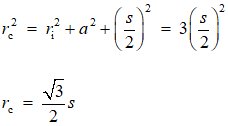
The CubeThe cube might also be called a regular hexahedron. It has 6 square faces, 8 vertices, and 12 edges. Three faces meet at each vertex. Of the Platonic solids, the cube does not have the least number of faces or vertices, but it is surely the simplest by any other measure. For that reason, this page will not waste too much effort on tedious derivations of obvious measures. In the following, we consider a cube of edge length s.
Other PropertiesThe cube has 48 symmetries. The cube is the dual of the octahedron. Connecting the centers of the adjacent faces of a cube results in an octahedron, and vice verse.
One other Platonic solid can be found inside the cube. Pick four of the vertices and fit a tetrahedron. A cross-section of a cube can be an equilateral triangle, a square, or a regular hexagon.
A planar projection of a cube can be a square or a regular hexagon.
Here is an interesting physical property. Pick up a cubic playing die, and twirl it like a top. Although it does not have radial symmetry, it will seek a vertical axis through two opposite vertices.
Watch this space for more on space filling solids. Last update: June 3, 2026 ... Paul Kunkel whistling@whistleralley.com For email to reach me, the word geometry must appear in the body of the message. |
||||||||||||||||||||||||||||




 Finally, here is a property that is important in design. The cube packs space. It is the only Platonic solid with this property. Buildings, books, appliances, and containers all tend to be in the shape of rectangular prisms (not necessarily cubes). This is not because designers lack imagination. Things just fit better that way. For efficient use of area and space it is hard to beat a right angle.